Showing posts with label editing. Show all posts

Wednesday, March 1, 2023

Editing is where it's at!


Last night I sent a novella off to my editor. 

Such a simple sentence, but it represents SOOO much work! LOL. I'd promised to get The Novella From Hell to her by the end of the month (of February) and over the weekend it dawned on my that the end of the month was NOW. I was about seven thousand words shy of where I wanted it to be, and the thing needed a solid edit before anyone - let alone an editor - could read it.

When I'm drafting, I'm likely to do thinks like change a side character's gender, decide I want to cut Character X and use their name for Character Y, change the point of view (POV) from first to 3rd (or the reverse - either way is not recommended) or make sundry other major modifications. 

Once I changed a book from m/f to m/m after I couldn't get past the first chapter of the m/f version. (The m/m version is Aqua Follies, which worked out pretty darned well, if I do say so myself.)


Basically, during that first draft, anything is fair game. I throw a bunch of words at a document and see what sticks. Creating the first draft is fun, because I get to see where the story is going to go, but I really love the editing process. Once I can see the bones of the story, then I can make it pretty.

There is a method to my madness. When the first draft is complete, I'll do a re-read, leaving comment bubbles and highlighting the things I need to fix. I'll sometimes leave the last chapter undone, because the process of cleaning things up might show me how the story actually ends. If it's a full novel (or a novella where I have the time lol) I'll make an excel workbook with a page for the story calendar, a page for the outline, and a third page for the punch list.

The calendar is pretty self-explanatory and the punch list is something I create toward the end, to show me what still needs work. For the outline, I track the chapter number, the word count, the POV (if there's more than one), first line, last line, a chapter/scene summary, the plot threads it hits, the romance arc, and any notes. 

Here's a screen shot of my first couple chapters of The Lighthouse Keeper, coming to you sometime this spring.
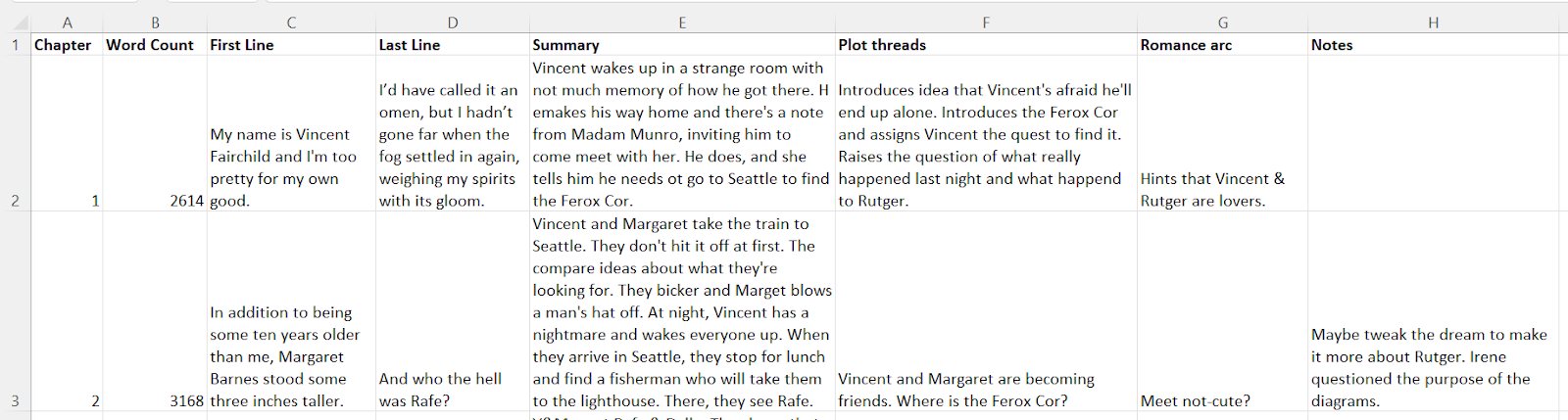

Sometimes I'll add an additional column for scenes, if there are more than one in a chapter. Word count is important because I think there's a rhythm to chapters, and I want them to all be more-or-less the same. If there's more than one POV, I want to make sure each character has about the same page time. I also like to look at first line and last line, to make sure they're not all the same. 

For example, the outline for my book Lost & Found showed me that the POV character stormed off in anger at the end of at least three chapters, maybe more. It wasn't a good look (lol) so I changed a couple of them.

Creating the outline is slow work, but I learn so much from it that for me it's worth the time. It shows me "scenes" that don't actually accomplish anything and gaps that I need to fill in. My "rules" about chapter length and POV word count are malleable; if I can think of a good reason why Chapter X needs to be twice as long as any other, I'll go with it. I just want it to be a conscious decision. Once I start rewriting, I sometimes add another column with a summary of how the scenes actually end up, or how I think they should end up, especially if I end up doing major surgery.

Because yeah, sometimes surgery is required.

Writers spend a lot of ink (e-ink?) debating whether they're plotters are pantsers, but I think there's almost as big a divide between drafters and editors. My writing partner Irene Preston and I are a good illustration of that divide. Irene sweats over each word, carefully placing them exactly where she wants them to go. I just want to get the words down so I can get to fixing them. She spends a lot of time pondering her characters' motivation before she starts, while I get to know my characters as I go. 

We could not be more opposite, and tbh editing our shared projects can get a little tense.

We've survived six books (and counting), so we're making it work. It's been good for me to learn someone else's process, and I think she's learned from me, too - even if she does want to wring my neck a lot of the time.

At any rate, this weekend required a fairly streamlined approach to getting The Novella From Hell ready for the editor. Saturday I wrote 1100 words, Sunday I wrote 5000 (!!!) words, Monday was a wash because Life, and yesterday I sat down at the computer at 0630 and sent the email to my editor about 5:30 pm. It was a looooong day, but I'm pretty happy with the outcome. 

Until she gets back to me with all the stuff I need to fix.

But hey, it's editing, so I'll have fun!


Monday, April 20, 2015

The Feels. Do we want them? How do we get them?

So...the other day my friend Irene posted to Facebook that she was reading the 4th book in a series by an author we both really like. That motivated me to get my but in gear and read the same book - I'd been saving it for a special occasion, and a Hawaiian vacation seemed special enough.

Loved the book. Hard.

(Jump HERE to see the book's Amazon link. I don't mean to be coy, but I blog about this author a lot, and there should be a limit to the fangirl action, you know?)

(Okay, fine. It's Jackdaw by KJ Charles. Fantastic story. Go read it. Seriously.)

At any rate, after I finished the book (for the 2nd time) I messaged Irene to ask what she thought. She loved it as much as I did, because unlike the other books in the series, this one was all about The Feels. A while later she dropped a different author's name, saying how much she admired her ability to write The Feels.

Those words again.

The Feels


Now, I haven't been living in a box, so I've seen people use the phrase before, but I'd never really connected it to my own writing. Should I try and write The Feels? What does that mean, exactly? And how would I go about doing it?

The best way to understand something is to start with an accurate definition. I went to Urban Dictionary, however had trouble finding something short AND grammatically correct AND F-bomb-free.

Not that there's anything wrong with that...exactly...

Then I found knowyourmeme.com, where there was both a definition and some information about the origin of the term. Check out the link if you want to feel like an expert on The Feels. For the rest of you, here's their definition:

“Feels” is a shorthand for the word “feelings” that is used to describe an intense emotional response, such as sadness, excitement or awe. The term is also commonly associated with the phrase “right in the feels,” which indicates that something has deeply affected the speaker.


Intense emotional response. That's what I want for my readers, maybe not on every page, but often enough to keep them turning those pages. Assuming my characters are more perceptive than poor Sherlock up there, how do I communicate their emotional response to any given situation?

After reading through a few blog posts (links below), I came up with six basic guidelines for adding emotional depth to your fiction.


1. Show, don't tell.


Every writer, everywhere has been told to 'show, don't tell' at one point or another. But how do you do that? It's not easy, or it wouldn't be something every one of us needs to be reminded of. As an example - and making use of Mr. Ackles, above - it's the difference between saying,

"He got all excited and started playing air guitar."

and

"He high kicked and grabbed his own damned leg, strumming his thigh like a guitar and shouting out the lyrics of some rock song."

The first sentence tells you he's excited, the second one communicates his emotion through word choice and detail. Giving your character physical cues that illustrate what's going on inside their head is much more powerful than baldly stating what they feel. T
he Emotion Thesaurus is great for this, providing a lists of behaviors associated with a host of different mental states.

You can and should amplify a character's emotions with visceral responses, with cues like a racing heartbeat or a twist in the pit of their belly, and you can use the choreography of the scene to provide clues to what they're feeling. A character who spends an entire conversation folded in a ball at the far end of the couch is giving a much different message than one who is straddling her love interest's lap.

You need to really know your characters, because the same situation can produce different responses in different people and you want to capture each character's unique truth. You also need to be willing to get down and dirty with your own feelings...but we'll get into that more in #3.


2. Give the reader something they can relate to.


There aint' nothing sadder than a bummed-out baby.

Look at that kid's face. You don't even need to know the cause to see his little heart breaking. Almost everyone's got some experience with babies, and as a story element, they're something most readers can relate to. I'm not saying every book needs a baby, but even the oddest, least-human character needs some aspect the reader can grab onto and say, "yeah, I know that."


If the reader connects with your main character in chapter one, they'll be sobbing or screaming or tearing their hair out when they get to the climax of the story. Readers are pretty forgiving, and will add their own layers to the information the writer gives them, but there needs to be a foundation of believability for them to work with.

Establishing a reader connection can make your antagonist more powerful, too. Not too many writers can get away with creating a Sauron. Most of us need to construct bad guys who have a little bit of good to offset all the evil, or whose motivations - selfishness, greed, addiction - can be understood by the reader.

I may not be telepathic, but I do know what it feels like to be the odd one out, to be the one who doesn't quite fit. So by the end of the first chapter of Dead Until Dark, I was pretty sure Sookie Stackhouse was someone I could be friends with, someone who would understand my own feelings of alienation, because she'd been there and done that. I rode that feeling of connection all the way through thirteen books and quite a few seasons of the television show.

Charlaine Harris won my loyalty by her ability to consistently get at honest emotional truths (and Eric Northman). In order to do that, she had to be willing to go there first.


 3. Open yourself up.


Basically, if you're not feeling it, your readers won't, either. 

I've heard writers say their best scenes are the ones where they made themselves cry, and there's something beautiful about that. To take your character into their blackest moments by digging into the time you hit rock bottom takes a fair amount of courage. Readers know what bad feels like, what hurt feels like, what fizzy infatuation feels like, and when you find a compelling way of communicating basic emotional truth, the words pop right off the page.

Which is not to say your writing should be limited to those things you've already experienced. You just need to come up with the next best thing. Probably Charlaine Harris has never met a vampire, but she makes a pretty good case for what it would be like. Most of us have met someone who was extremely charismatic and kind of frightening. Like, you know, a vampire would be. Ms. Charlaine's ability to convey the competing dynamics of attraction and fear gives her work the weight of truth, even though the situations are complete fantasy.

What's that I just said about competing dynamics? It's just a fancy way of saying a character's emotion rarely plays only one note.


4. Layer emotions.


Remember the time your sister came home and told you she'd made the cheerleading squad, and you were happy for her because you're sisters, after all, but you were also a teeny weeny bit jealous, because you're sisters, after all, and you were also also kind of excited because maybe your own dating cred would go up because of some trickle-down cool?

Because you're sisters, after all. Remember?

It's entirely possible for your characters to have mixed emotions about any given situation. To use an example from the KJ Charles book Jackdaw, Ben hated Jonah, except for how much he loved him. And Jonah loved Ben so much, he destroyed their relationship to keep him safe. The complexity of these extreme emotions (The Feels) drove the plot hard and made for compelling reading. 

(This post from Janice Hardy's Fiction University does a great job of detailing how to identify the different emotional layers in a scene. Check it out - it's worth a read.)

5. Use your setting


In #1, I talked about using behavioral cues, visceral reactions, and choreography to illustrate a character's mental/emotional state. Another way of reinforcing what's going on inside their head is to highlight details from the setting. The details you choose should help deepen the reader's connection with the character, thereby heightening their emotional response to the action on the page.

Think about it. Wuthering Heights is a very different book if it's set in contemporary L.A. (And I'm already playing with that idea, so don't even go there.) The whole dark-and-stormy-night vibe fosters a feeling of dread in the reader, one that reinforces the pathos and destructiveness of Cathy and Heathcliffe's doomed love.

More subtly, if most of your action takes place in a fairly benign suburban ranch house, maybe there's a dying potted plant in the corner that comes to represent the stress between the husband and wife who live there. A little bit of setting can go a long way, but a couple choice details can really hook your reader, increasing the emotional resonance of the scene.


6. Show some restraint.


Melodrama.

It's not usually what you're after. Melodrama happens when your character's emotional intensity is constantly turned up to eleven. (That's a random Spinal Tap reference.) If the hint of love has them singing about daisies and rosebuds, and a bad cup of coffee brings on tears, you might have a problem.

A character doesn't have to express over-the-top feelings in order to be dramatic. You're striving for the truth, right? And just as people quite normally feel more than one emotion at a time, there are also ten steps on their emotional volume control before they get to eleven. To avoid a melodramatic, potentially comedic, overreaction, make sure you calibrate the character's response to the situation you're creating.

There may be times when you want a character to overshoot, for a deliberately humorous effect. Janet Evanovich is pretty much an expert at this, and Stephanie Plum's sidekick Lula gets just as excited about a bucket of chicken as she does about a bad guy with a gun. In general, though, it's best to leave the melodrama to Snidely Whiplash and his pals.


So there's my take on how to hit your readers right in The Feels. Show, don't tell. Give them something to relate to. Open yourself up. Layer emotions. Use your setting. Avoid melodrama. And while you're doing all that, strive to put the truth on the page, because that'll give you the biggest feels of all.

Cheers,
Liv


If you've got any tricks for getting The Feels on the page, leave 'em in the comments!

Wish I'd known she was going to do this so I could have worked it in earlier...my friend Irene took my post and did it one better. Here's a link to The Feels (topic shamelessly stolen from Liv Rancourt)! She pretty much nails it....


If you'd like to do some more reading, here are some links...

http://theeditorsblog.net/2011/01/30/creating-emotion-in-the-reader/

http://theeditorsblog.net/2011/01/21/writing-for-the-emotions/

http://writershelpingwriters.net/2014/02/writing-extreme-emotion-without-melodrama/

http://blog.janicehardy.com/2011/10/do-you-feel-it-plotting-with-emotional.html

Tuesday, January 6, 2015

Eradicating Thats, or, Pet Words & Why We Love Them

Scene from the Aqua Follies, part of Seattle's 1950s Seafair celebration.

For the last two days, I've been working on lowering the number of times the word "that" appears in my current WIP, Aqua Follies. I started at just under 360. I'm at 136 now, and my goal is to get it down to around 50. 

Yep, my WIP is on a that diet.

And when I'm done with that (heh), I'm going to move on to the next word on my Pet Word List.

Was.

Now, was is a fairly useful word. I mean, states of being are ubiquitous, unless the story is happening in a vacuum. (Momentary existential tangent!) On my was pass, I'll look for examples of passive voice construction - and the reasons for avoiding passive voice make a whole 'nother blog post. (Though you can jump HERE for some examples of the difference between passive and active voice.)

Pet words are a problem for a number of reasons, but the most important one is they make your work boring. With all the words in the English language, you're going to make me read just 400 times in your novel? Seriously? Or then there was the NYT bestselling author who started three sentences in the same paragraph with the word meanwhile. Monotonous, careless, and actually kind of funny, in a not-terribly-amusing way.

I find if I repeat a word too often, I'm writing lazy. When I do a pet word search to clean up the frequent flyers, I almost always improve clarity, and often manage to communicate my meaning in fewer words. Consider the next couple sentences...

Jack Dodson was slender, with a receding hairline and a gaze that said just get to the point.

OR

Jack Dodson was slender, with a receding hairline and a just-get-to-the-point gaze.

IMHO (and you're welcome to disagree) the edited version is cleaner and  tighter. It gets rid of the micro-conflict created by "gaze...said", which could be kind of fun, but could also be tiresome if it bumps the reader either because gazes don't speak or because it's heading toward clicheville.

Clicheville. The place you never, ever want to go.

Here's another example of how getting rid of a pet word like that can improve your language. This edit has the added bonus of getting rid of a was, too.

The other verdict Russell reached was that regardless of how things worked out with Skip, he wanted to stay in Seattle, where he could smell the salty ocean air from just about everywhere, and where he could walk into a bar with other men who thought like he did.

OR

His moment of insight brought him to a second conclusion. Regardless of how things worked out with Skip, Russell wanted to stay in Seattle...

They both deliver the same information, but I think the second version is a little more polished, which fits better with the upper middle-class, college educated POV character.

So pet words make your work boring, and fixing them will make your writing stronger. Sounds simple, right? Except for the fact that I've spent the last two days eradicating thats, and I've got about 20 other words on my list. 

This might take a while.

The subject of pet words has come up on a couple different Facebook groups I'm on, and minimizing pet words is the kind of thing that'll impress a prospective agent or editor. My observation has been that my pet words change, depending on the project I'm working on, which is why I keep a running list. Writing teacher Rayne Hall will say that a word shouldn't appear more than one time in 1000 words, so I use that as my general rule of thumb.


What about you? Do you have pet words that turn up again and again in your manuscript? If you're not sure, jump HERE to a pretty good blog post that includes a list of common pet words. Check it out, then see how many times you use some of these in your work. (And you'll get bonus points if you leave your top three pet words in the comments!)

Peace,
Liv


Monday, April 16, 2012

Monday Morning Post: Mash-Up Edition

Finished another short story yesterday. It's called The Loft, and I'm hoping it'll be included in an anthology of horror stories. Never tried to write a scary story before, and I have no sense of how successful I was this time. It's good to stretch, though.
                                                                       (Burnsie the dog discovers his passion for gardening.)
So spending yesterday wrestling with the laptop has me inclined towards blogs with a writing theme for today's mash-up. First, you should check out Sara W. Foster's post
Married To Her Father's Foe. It's a true story from the American Revolution, and I gotta think there's a historical fiction writer out there who'll be truly inspired by it.

Next, you should check out this post by A. Victoria Mixon: 3 Things To Know About Exposition & Telling. Victoria's an editor, writer, and blogger, and I love her posts because she's so smart and she says such intelligent things about writing. This post examines how the contemporary fascination with exposition is effecting what gets published, and in a later post she looks at some of the reasons why. Both of them are worth checking out.

Triberr introduced me to Melodie Wright, who blogs at Forever Rewriting. She's been involved in the A to Z Challenge - blogging on a different letter of the alphabet every day of the month of April, and you should look at her post K is for: keeping faith.  It includes a Vlog interview with NYT bestselling author Beth Revis and it's the most encouraging piece about failure you'll ever see.

This next one isn't exactly writing-related, but Julie Farrar wrote a thought-provoking piece about the Ashley Judd controversy in Who's the Worst Enemy of Women Julie's post contains a link to the essay Ms. Judd wrote about how women get unfairly judged by their appearance at every turn. Given that I'm turning 50 later this week, the whole kerfufle is really resonating, and Julie does a good job of expanding on the points Ms Judd makes.

Then, for something completely different, take a look at Ann Cory's Bawdy Talk - Sweet Saturday Sample . Her snippet's a tease, and I loved it. Her A to Z Challenge posts all show pics of dreamy vacation spots, and I liked this week's Six Sentence Sunday post, too, but it was a little too naughty for my PG rating. You can go there if you like. I won't tell...
;)
Peace,
Liv